

How did you not know the protagonist was Black? - The Default Whiteness Phenomenon. How it happens and how to stop it in your own writing.
There’s a strange trend you may have noticed as a reader from time to time, especially on BookTube or BookTok. A fellow reader is engrossed in a book. They read it cover to cover, maybe even read it twice. And they finish having absolutely no idea that a main character was a person of color.
When you or someone else informs them of this fact, they’re shocked. And sometimes they might get angry, rejecting the possibility. Nevertheless, it’s the truth; it says so in the source material. But for some reason, it didn’t stick; it didn’t leave a lasting impression on the reader. Thus rendering their attempt to diversify their cast completely worthless.
Why does this happen? How does this happen? And how do we make sure this doesn’t happen with our own stories?
In this post, we’re breaking down the science behind the “Default Whiteness” phenomenon, what happens in the brain that makes it occur, and how to make sure your characters of color are visible, vibrant, and unforgettable.
The Problem
Prototypicality Bias
Without clear, consistent, and high-quality physical descriptions for your characters, you leave a lot of space for the “Default Whiteness” phenomenon to occur. This phenomenon is a sort of prototypicality bias; our brain tends to make judgments in favor of ideas, concepts, or even faces that are socially "typical". In this case, the default whiteness phenomenon is a mental shorthand where readers assign white identity to characters unless they are explicitly told not to, clearly and repeatedly. They assume whiteness by default because that’s the norm.
Ebony Elizabeth Thomas explains in The Dark Fantastic that the fantasy genre is often deeply steeped in white supremacist mythologies, oftentimes encouraging readers to expect whiteness to be at the center. This could lead to the “imagination gap”-- the inability or even unwillingness on the reader’s part to imagine non-white characters as fantastical heroes unless the text actively and continuously forces them to by disrupting their assumptions.
To get a better understanding of how this phenomenon functions in real life, let’s take a look at a case study.
The Case Study: Rue in The Hunger Games
In Suzanne Collins’s The Hunger Games, the character Rue is described in the text as having "dark brown skin and eyes." But when the young Amandla Stenberg was cast for the role in the film adaptation, it triggered a huge racial backlash on social media.
Many fans of the series claimed that this casting choice was a “political agenda” and that hiring a black actress for this role “erased the integrity” of the character…. A character described as black in the source material to begin with.
And many were vicious, taking to the internet with racist tweet after racist tweet to voice their strong (and wrong) outrage over this casting choice. How do readers who claim to be die-hard fans of the series come to this conclusion? Why does this happen?
When a character's race has only been mentioned once with a very simple label (e.g. “she had brown skin”), the brain tends to categorize this as a semantic fact as opposed to an episodic detail that’s integral to the character’s lived experience and worldview. Almost like it’s a throwaway detail. Without continuous reinforcement, the reader’s mind applies a thought substitution strategy, quickly and seamlessly replacing the atypical character description (the character’s blackness) with the default image of whiteness.
The Solution
Representation is all about making sure underrepresented communities are actually seen. When writers don’t dedicate the time and intentional focus necessary to write quality physical descriptions, their stories fall short of this goal, allowing ample opportunity for readers to fall back on these subconscious mental shortcuts.
Physical descriptions are passages dedicated to describing your character's appearance and overall vibe. Writing quality descriptions and peppering them throughout is the key to solving this problem.
How to conquer the forgetting curve
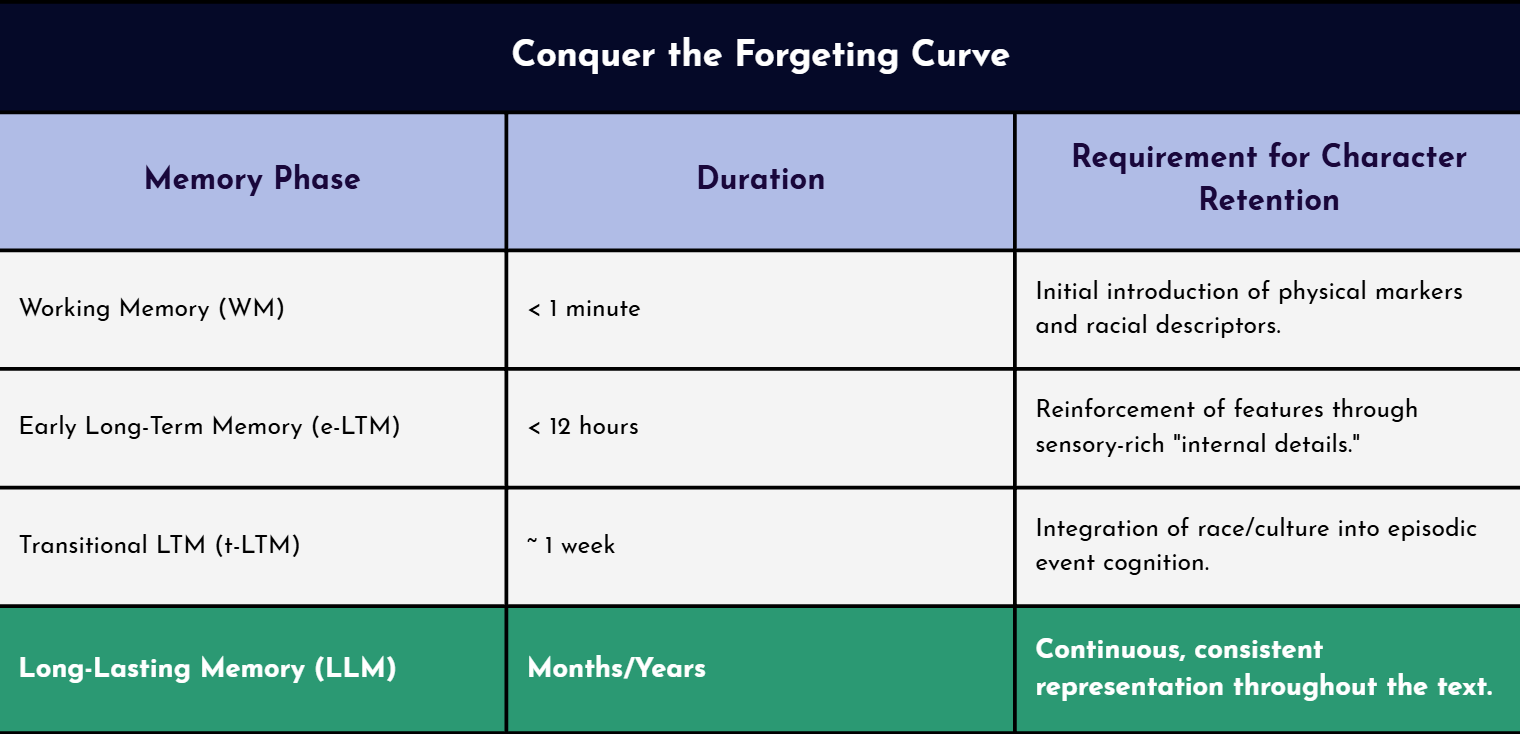
As we all know, our memory tends to decline as time passes. Cognitive psychologists propose a "Memory Phases Framework" consisting of:
Working Memory (WM) [Under 1 Minute]: For our purposes, this is the initial introduction where you establish racial descriptors and physical markers.
Early Long-Term Memory (e-LTM) [Under 12 Hours]: This is the reinforcement of features through sensory-rich, internal character details.
Transitional LTM (t-LTM) [Around 1 Week]: This is the seamless integration of race, culture, and appearance into episodic event cognition and plot action.
Long-Lasting Memory (LLM) [Months/Years]: This is the continuous, consistent sensory representation maintained throughout the entirety of the text.
For a character’s race to persist through a 400-page novel, which may take days or weeks to read, we need our descriptions to elevate into LLM.
I’m gonna walk you through what I teach my students in my writing workshops. The biggest obstacle my students face is honestly fear and anxiety. We know we need to do more than use a single label; Mentioning a character's race once in an isolated tag allows the reader to file it away as an abstract note instead of the character’s lived reality. But we’re afraid of doing it wrong, so much so that we avoid doing it at all.
Your fear of representing your characters of color poorly essentially becomes a self-fulfilling prophecy; you undercommit, guaranteeing that your characters' culture won’t be seen at all.
If we’re going to do this, we have to do it right, which means pushing past our fear and committing to BIPOC Representation fully. We have to go all in.
The Sensory Method
To warm up my writers, I recommend the sensory method: anchor ourselves in a few of our 5 senses to be as descriptive as possible. The main ones will be sight, scent, and sound. Typically, I set a timer, prompting my writers to have dedicated time to reflect on each sense and jot some notes down. Give it a try!
Sight
This one is obviously the most important. You want to take the time to go deeper here. Describe their skin as well as their undertones. Describe their hair texture and hairstyle in detail. Imagine their facial features or body shape. Physical descriptions are also great places to add cultural references like fashion, makeup, and accessories tied to their culture.
For inspiration, I always reference the “Writing with Color” blog, it’s a favorite amongst my students. I love the creative ideas they have for ways you can describe the color of someone's skin using words like chestnut, copper, topaz, onyx, or gold.
Stay COMPLETELY away from foods like chocolate, caramel, and mocha. Food descriptions tend to encourage the fetishization of characters of color.
Scent & Sound
You can spice up your physical description with some details regarding scent and sound. Close your eyes and imagine your character were sitting right in front of you. How do you know it’s them?
Do they have a signature scent that envelopes you in warm vanilla or energizes you with electric citrus and bursting berries? Can you tell by the distinct timbre of their voice or the cadence of their speech? Would they reach out and touch your hand with a softness you know is theirs?
Ground yourself in their presence; imagine what it would be like sharing a physical space with them.
Aura & Energy
This is a bit abstract, I know, but follow me here. Describe the 'vibe' a character projects and how they impact the energy in the room. How do they impact the people around them? How they make others feel. How does the temperature shift, and how can you tell? Does the room feel lighter, darker, warmer, colder? And why?

Read & Analyze Descriptions
Beyond the sensory method, I also recommend making a habit of reading and analyzing character descriptions often.
Read books written by authors of color and take note of moments where the author visually describes the character. What do you like about their description? What’s working well?
How do they make the descriptions feel vivid? How often do descriptions appear?
Keep a running notebook or Google Doc where you keep all your insights as you’re reading. Over time, you’ll notice patterns, and while you don’t ever want to copy or plagiarize, you can learn things to help you improve your technique and execution.
Make your character descriptions Professional!
Okay, so you’ve got a few new tools in your arsenal. Practicing the sensory method on your own is the fastest way to clear up confusion and stop the default whiteness phenomenon from even having the opportunity to occur.
But we’re not done yet. Simply knowing the theory behind memory phases won’t fix everything. Growth really happens when we’re challenged and given feedback.
That is exactly why I created The Color-Word Challenge. This writing challenge is for writers just like you, who care deeply about representing characters of color with respect. With extra guidance, we can get you there.

Write Better Characters of Color — Take the Color-Word Challenge!
Struggling to describe your characters of color with power, precision, and respect? You're not alone — and you're not stuck. The Color-Word Challenge is here to sharpen your skills, stretch your creativity, and help you write physical descriptions that truly resonate.
In the Color-Word Challenge, you will…
Write an intensive character description of up to 500 words. Feel free to use a character from your story or just pick a photo as a prompt.
Submit what you wrote for thorough, professional review to identify blind spots and elevate your description.
Get direct feedback from me! And together we’ll break down your description line-by-line and sharpen your sensory techniques.
Eliminate all fear and anxiety. You’ll walk away feeling confident that you can write amazing character descriptions moving forward.
You can take the private color-word challenge here and book a call with me so we can work through it together!
And if you’re feeling brave, you can submit it for review on my YouTube channel completely for free! Click here to join the Free Color-Word Challenge (YouTube Edition).

Write Better Characters of Color — Take the Color-Word Challenge!
Struggling to describe your characters of color with power, precision, and respect? You're not alone — and you're not stuck. The Color-Word Challenge is here to sharpen your skills, stretch your creativity, and help you write physical descriptions that truly resonate.
