

🧜🏾♀️ West African Fantasy & BLACK MERMAIDS! Authentic Fantasy with Skin of the Sea
What if you were a mermaid created to serve a powerful deity, collecting the souls of those who die at sea to bless their journey back to the Supreme Creator? But on one fateful day, a living boy falls into the ocean. When you swim down to collect his soul, his eyes fly open. He’s alive! If you don't act immediately, he will drown—but saving him means defying an ancient decree of the gods. What would you do?
If you are a fiction writer trying to weave rich, authentic characters of color and immersive cultural mythology into your worldbuilding, you’ve probably felt the frustration of wondering: How do I describe my characters with power and beauty without resorting to clunky info-dumps? How do I make my diverse fantasy world feel authentic and deeply rooted?
Don't worry, my fellow creative—I’ve got you! Today we’re breaking down the masterclass writing techniques in Natasha Bowen’s incredible West African fantasy novel, Skin of the Sea. We’ll analyze how Bowen seamlessly peppers in physical descriptions, integrates 4 key types of cultural references, establishes high-stakes internal hooks, and crafts an unforgettable inciting incident all within the first 4 chapters!

Weaving Character Descriptions Throughout Dialogue
Take a look at how Natasha Bowen introduces Folasade (a fellow Mami Wata mermaid) in Chapter 1:
"Simidele." The voice is like a vine, sneaking through the water and teasing out the hint of a smile from me. I turn, sweeping my arms through the water in arcs, taking in the deep purple scales and round face of Folasade... Folasade is small, but her smile is large, her eyes reflecting every feeling that ripples through her. (Chapter 1, pg 5)
Nodding, I let Folasade sweep my curls away so that we can see each other's faces clearly. Her eyes are almost black in the water, but they shine with a reverence I know is missing from mine. (Chapter 1, pg 6)
Key Craft Takeaways:
Pepper, Don't Info-Dump: Notice how Folasade’s appearance is revealed through action and movement (sweeping arms, brushing curls away) rather than a static visual inventory.
Filter Physicality Through Voice: When Simi notes that Folasade’s eyes "shine with a reverence I know is missing from mine," we aren't just getting a physical description—we're getting Simi's internal insecurity and perspective. I really liked this! It doesn’t just reveal what Folasade looks like; it shows us how she appears through our protagonist’s eyes!
4 Types of Cultural References in Fantasy
Cultural references are authentic, accurate attributes of a culture or community that make a setting unique, identifiable, and emotionally resonant for readers. When building a fantasy world inspired by real-world cultures, it’s important to incorporate references that are most compatible with their story and the characters. It doesn’t make sense to just add them in willy-nilly. They have to serve a purpose and move the story forward. These four reference types I noticed in the very first 4 chapters of the book.
1. Architecture & World Layout
Skin of the Sea Example:"The city is cocooned by forest, set out in concentric spirals that begin with the Alaafin's palace and end with a great wall that encircles it all."
Why It Works: It immediately grounds the reader in West African architectural history, giving the setting a distinct structural identity beyond generic European fantasy castles.
2. Fashion, Clothing & Hairstyles
Skin of the Sea Example: Young girls with hair braided in the ipako elede style, or wrappers woven in midnight blue with gold and silver stars.
Why It Works: Hair textures, braided patterns, and textile choices carry deep cultural significance. Celebrating these details adds richness and vibrancy to every scene.
3. The Tradition of Oral Storytelling
Skin of the Sea Example: Elders gathering around the campfire as the principal storyteller shares tales of Olodumare (the Supreme Creator).
Why It Works: Across the African diaspora, oral history has always been a vital vehicle for preserving truth, wisdom, and heritage. Incorporating oral tradition honors how history is passed down.
4. Cuisine & Multi-Sensory Scents
Skin of the Sea Example: Elders clutching dried papaya and fried plantains, snacks from the market that "fill the air with spice."
Why It Works: Food engages all five senses! Evoking the warmth of a campfire, the sound of laughter, and the scent of fried plantains creates immediate emotional intimacy for the reader.
Hooks, Internal Conflict & The Inciting Incident
The Hook = Desire vs. Fear
The secret to an irresistible story hook is internal conflict: the clash between what your protagonist desires and what they fear.
In Skin of the Sea….
Simi’s Internal Desire: Gaining memories of her past human life, her family, and her mother.
Simi’s External Goal: Wondering what it would be like to return to land and become human again.
Simi’s Fear & Obstacle: Her deep love, duty, and respect for Yemoja (the powerful orisha who saved her and turned her into Mami Wata) as well as her fear of defying the ancient decrees of the Orishas.
This was an incredible setup for the inciting incident that comes next!
The Inciting Incident
In Chapter 3, a boy thrown overboard during the transatlantic slave trade falls into the ocean. And he is alive. His wide-set eyes instantly remind Simi of her mother. This emotional catalyst forces Simi out of her comfort zone: she must choose on the spot between obeying divine authority or saving a human life.
[ Normal World: Blessing Deceased Souls ] —> [ Inciting Incident: Living Boy Falls Overboard ] —> [ Internal Crisis: Duty to Yemoja vs. Saving Her People ] —> [ The Choice: Defying the Gods to Save a Life ]
I loved the way this was set up; we established what Simi’s task was, why she was already in the headspace to consider defying it, and the incident that would pressure her to make that choice. I thought it was masterfully done; it established the stakes quickly and made me care!
Skin of the Sea vs. The Little Mermaid
One of the things I really liked about this book was how much it reminded me of The Little Mermaid. And it’s not by coincidence! Bowen herself noted how much the original Hans Christian Andersen story inspired Skin of the Sea. While both stories share the trope of a mermaid rescuing a human man, Natasha Bowen elevates the stakes dramatically:
Ariel wants to join a surface world she has never known; rescuing a royal prince who nearly died at sea.
Simi, however, desires to reclaim a home and memory that was once hers. And instead of a prince, she rescues a boy who has been brutalized by colonialists. And though the Gods would tell her not to save him, she refuses to watch her people suffer without acting.
It is a story crafted specifically for Black women and girls, proving that authentic representation is far more powerful than simply swapping character palettes in existing tropes!
Download the Slide Deck so you can use these notes in your own storytelling!
When you download your Free Slide Deck, you will immediately be able to:
📊 Review Visual Summaries: Access clean breakdowns of Chapters 1–4, including plot points and structural hooks.
🧜🏾♀️ Reference Direct Excerpts: Keep examples of Folasade and Yemoja’s descriptions on hand for writing inspiration.
⚡ Master Story Frameworks: Revisit key definitions for internal conflict, inciting incidents, and cultural reference types whenever you need them.
You have nothing to lose! It is 100% free, delivered instantly, and gives you a stress-free way to keep all this valuable knowledge right at your fingertips.
🚀 Ready to Take It Even Further? Build YOUR Fantasy World!
The Slide Deck is helpful… but:
Sure, the Free Presentation Slide Deck helps you review the examples and concepts from Skin of the Sea.
But it can’t:
Give you custom prompts tailored to your unique fictional world.
Help you brainstorm fictional cultural attributes from scratch without falling into stereotypes.
Guide you step-by-step through mapping out your world's architecture, fashion, cuisine, and history.
Without a structured system to design your world, you could easily find yourself stuck during the planning phase, worrying whether your fictional setting feels flat or uninspired.
You’re a serious writer—you’re not here to mess around. You’re ready to go all the way, tackle the worldbuilding process with confidence, and take the next step toward completing your manuscript!
That’s why the Diverse Fantasy Worksheet is for you! This step-by-step digital guide is specifically designed for authors who find themselves stuck when integrating cultural diversity into completely imagined realms.
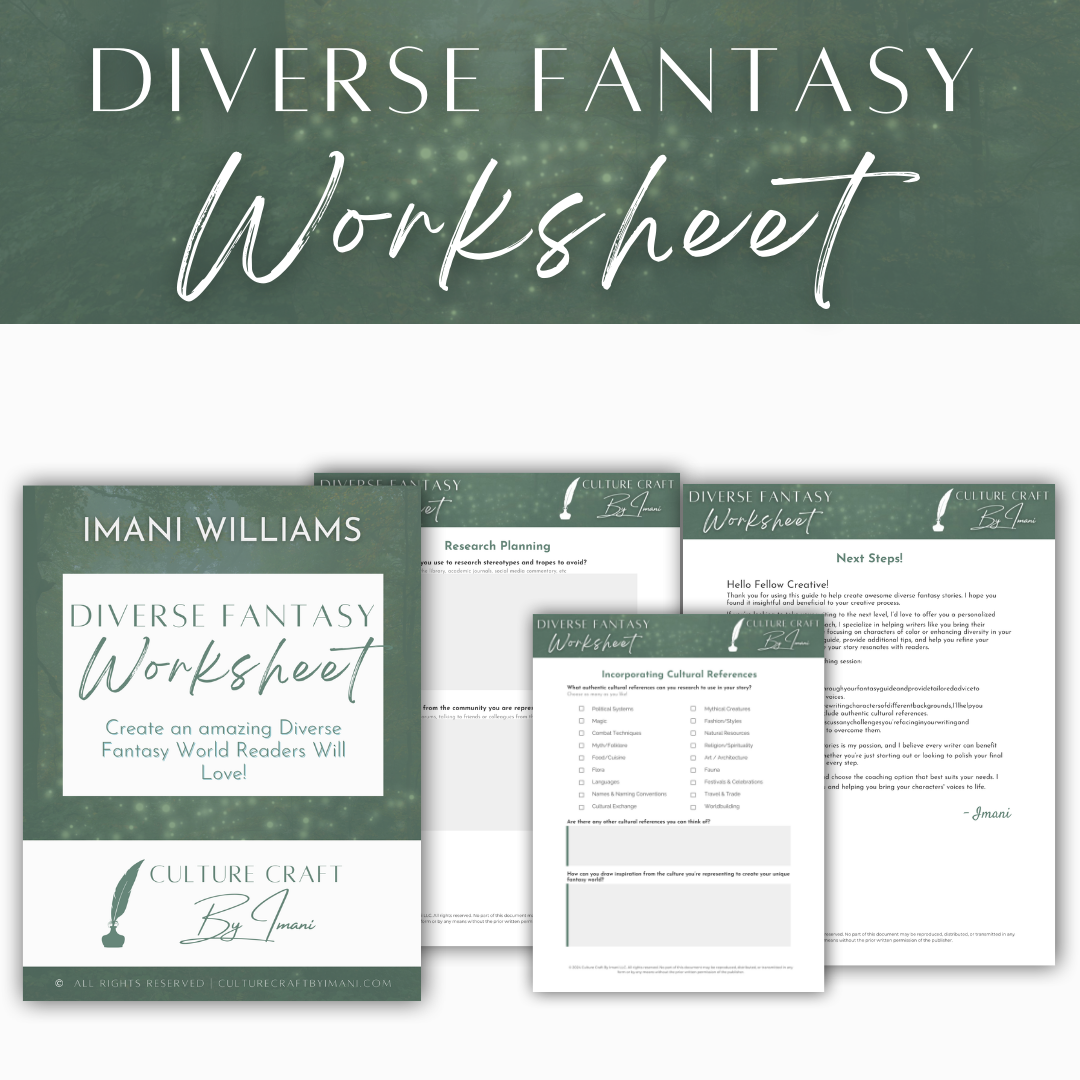
What You Get Inside the Diverse Fantasy Worksheet:
💡 Thought-Provoking Prompts: Overcome the "How do I add characters of color to a fictional realm?" headache with guided questions.
🎨 Curated Inspiration: Examples and brainstorming frameworks to help you envision diverse architecture, clothing, oral lore, and cuisine.
📝 Dedicated Journal Space: Ample room for reflection, world mapping, and character notes before you draft.
💻 Versatile Digital Formats: Available as both an interactive Google Doc and an editable PDF so you can type directly into it or print it out!
🔄 Infinite Reusability: Use it over and over again for every fantasy novel, short story, or series you ever write.
Unlike generic worldbuilding guides, this worksheet tackles the exact challenge that very few resources address: bridging the gap between imaginative fantasy worldbuilding and respectful, deeply authentic cultural representation.
Don't let the fear of getting it wrong hold your story back. Give your manuscript the depth, richness, and magic it deserves!

Unlock the Magic of Diverse Fantasy Worlds with Our Worksheet!
Are you a fiction writer yearning to create rich, diverse fantasy worlds? Look no further! Introducing the Diverse Fantasy Worksheet – your essential tool for weaving cultural diversity into your fantastical tales. 🌟
